
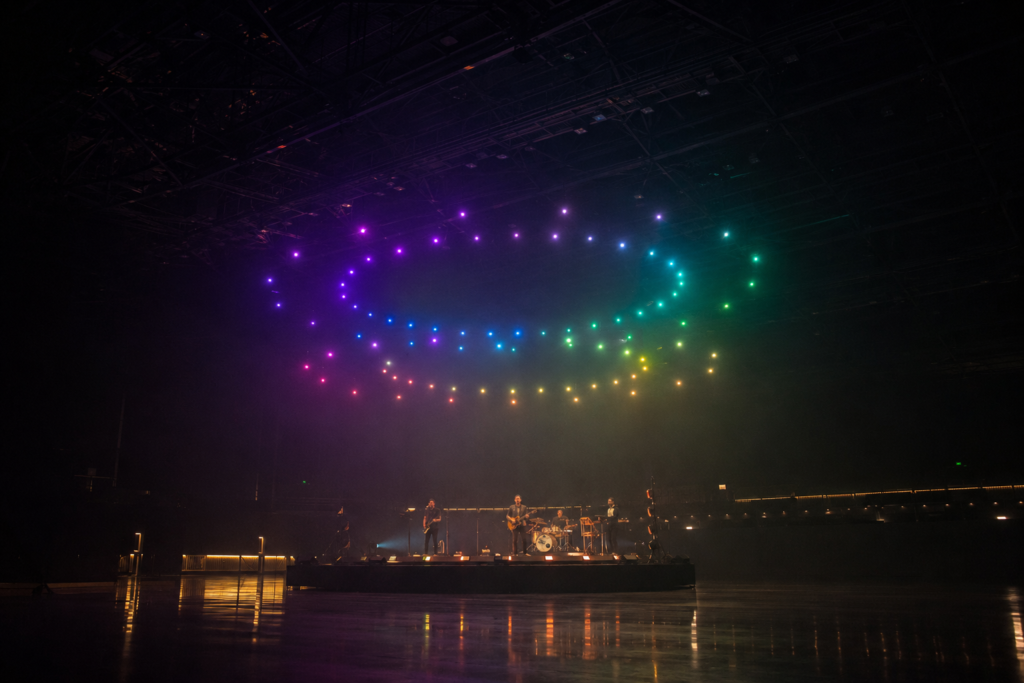
It’s tempting to assume that what makes a great indoor drone show is simply more drones, more colour, more movement. Having watched the field develop, we’d argue the opposite – the best shows tend to be the most restrained ones. Here’s what we think actually separates a memorable indoor drone show from a forgettable one.
It earns a moment, rather than filling time
The strongest shows we’ve seen – and read about, from Cirque du Soleil’s Broadway and Vegas productions to major tour and broadcast moments internationally – aren’t run as a general-purpose spectacle. They arrive at a specific point: a reveal, a countdown, an emotional peak, a closing statement. If you haven’t seen the basics of how any of this works yet, our explainer on what an indoor drone show actually is is a useful starting point before thinking about design choices.
It works with the room, not against it
Indoors, the venue is part of the design in a way it never is outdoors. Ceiling height, sightlines, existing staging and lighting all shape what the choreography can be. A show designed around the actual room – rather than a generic formation dropped into any space – reads as considered rather than templated.
That’s also why venue and audience type matter as much as the choreography itself. What lands well in a conference hall won’t necessarily land the same way in a theatre or a hotel ballroom; our overview of the best events for an indoor drone light show covers that in more detail.
Restraint over drone count
Indoor shows typically use dozens of drones, not thousands – and that’s a feature, not a limitation. A smaller number of drones, flown with precision at close range, tends to feel more deliberate and more impressive than a larger formation viewed from a distance. The best indoor shows lean into that: fewer elements, each one doing more work.
There’s a simple reason for this: at close range, an audience notices precision far more than it notices scale. A dozen drones holding a perfectly clean formation a few metres above a crowd reads as more impressive than a much larger group moving loosely, because the audience can actually see the detail.
It’s layered with everything else in the room
A drone show flown in isolation, with the house lights on and no other production around it, rarely feels as strong as one synced via timecode to lighting, music and video. The strongest shows treat the drones as one instrument in a wider arrangement rather than a stand-alone act – which is also where a lot of the technical planning work goes, particularly for conferences and corporate events running alongside a full AV programme.
It respects the audience’s time
Flight time for the drones used indoors is short by design – a few minutes per charge – and the strongest shows work with that rather than against it. A tightly edited minute or two that lands exactly on the right beat tends to stay with people far longer than a stretched-out sequence that outlasts its own impact. Knowing when to end a show is as much a design decision as anything that happens while the drones are in the air.
And, underneath all of it, reliability
None of the above matters if the show doesn’t fly exactly as designed. The redundancy and rehearsal built into every indoor show exist so the creative choices can be trusted to land on the night – which is, in the end, what makes the difference between a show that’s simply flown and one that’s genuinely great. A brilliant formation that stutters, or a cue that lands half a second late, undoes far more goodwill than a simpler show that runs perfectly.
If you’re shaping a moment for an upcoming event and want a view on what would work well in your venue, get in touch at hello@inflight.show or visit inflight.show.