
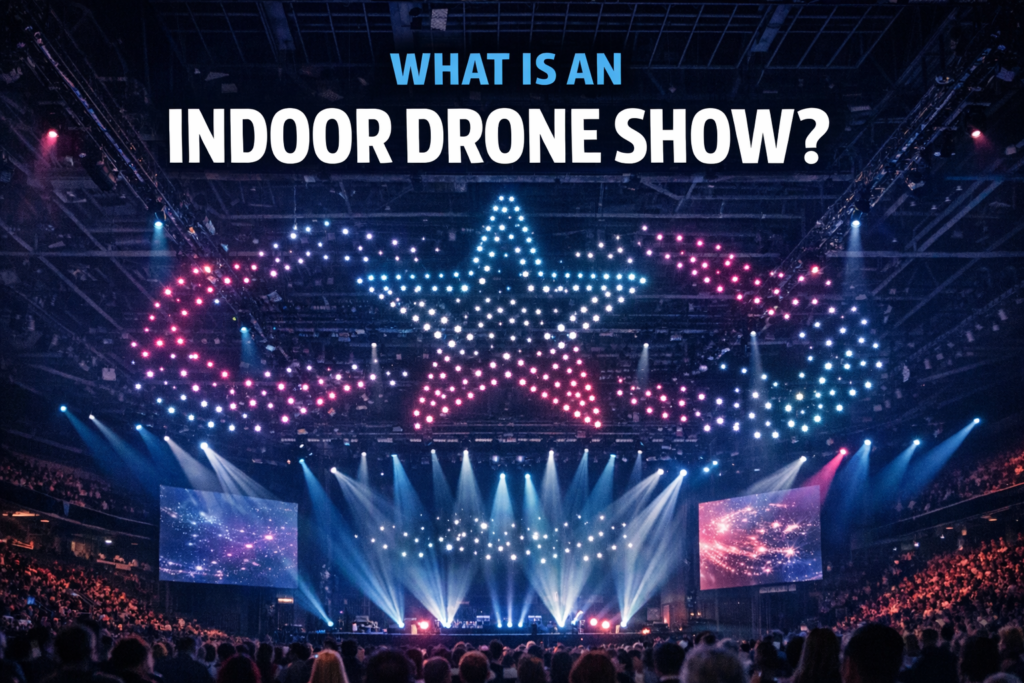
Drone light shows are now a familiar part of the events industry. From city-wide celebrations to large-scale outdoor productions, they’ve proven their ability to capture attention and create memorable moments.
What many event professionals don’t yet realise is that drone shows can also take place indoors — and in many cases, they offer a more controlled, reliable, and creatively flexible solution.
So what exactly is an indoor drone show, and how does it work in a live event environment?
A Simple Definition
An indoor drone show is a choreographed aerial performance using multiple small, LED-lit drones flying within an enclosed venue.
Rather than operating in open air, these drones perform inside spaces such as theatres, exhibition halls, and conference venues. This allows them to integrate directly with staging, lighting, and audience environments, becoming part of the show rather than something viewed at a distance.
The result is a precise, repeatable, and highly adaptable visual experience.
How Indoor Drone Shows Work
While the final effect feels seamless, indoor drone shows rely on a combination of advanced positioning systems, pre-programmed choreography, and carefully managed safety processes.
Positioning and Navigation
Indoor drones do not rely on GPS. Instead, they use a local positioning system created using a network of beacons placed around the venue.
These beacons act like a “satellite-style” system, allowing each drone to understand its position within a mapped 3D space. By combining high-level and low-level reference points, the system creates a highly accurate model of the environment.
This enables consistent, repeatable movement — even in complex venues with rigging, staging, and audience seating.
Choreography and Control
Every drone movement is pre-designed and programmed in advance.
These flight paths are synchronised with music, lighting, or live performance cues, allowing drones to become part of the wider production.
- Subtle movement to enhance atmosphere
- Sweeping formations across a stage
- Moments timed precisely to key cues
- Interaction with performers or scenic elements
Safety Systems
- Clearly defined flight boundaries
- Redundant control and communication systems
- Lightweight drones designed for operation above people
- Detailed, venue-specific risk assessments
Indoor vs Outdoor Drone Shows: What’s the Difference?
- Controlled environments with no weather dependency
- Greater reliability in scheduling and execution
- Closer proximity to audiences
- Integration with lighting, audio, and staging
- More precise and repeatable choreography
Final Thoughts
Indoor drone shows are still emerging within the events industry, but they are quickly establishing themselves as a practical and powerful creative tool.
If you’re exploring new ways to elevate an event experience, it’s worth considering how an indoor drone show could be incorporated into your plans.