
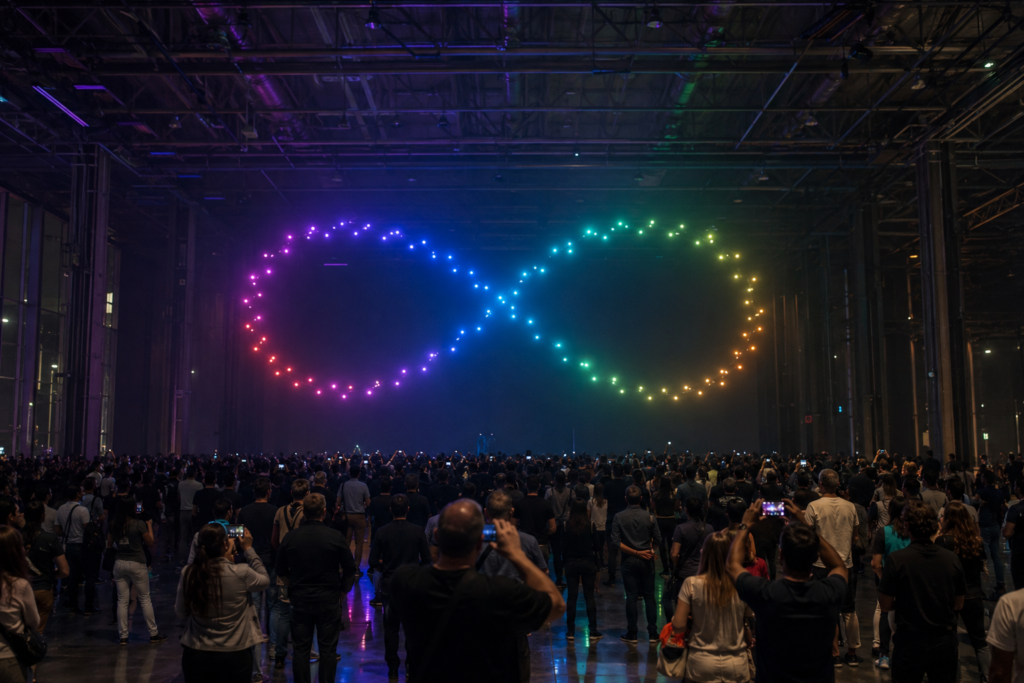
Because the field is still so new in the UK, myths about indoor drone shows spread faster than accurate information does. Most of them come from picturing an outdoor display and assuming it works the same way indoors. Here are five of the most common myths, and what’s actually true.
Myth 1: It’s just an outdoor show moved inside
This is the biggest misconception. Indoor drone shows are built on entirely different technology – non-satellite indoor positioning instead of GPS, drones designed to be small and light enough to fly above people, and heavy redundancy so a single fault doesn’t end the show. It’s a distinct field with its own engineering, not a scaled-down outdoor display, developed by a small number of specialist companies rather than adapted from existing outdoor drone-show kit. Our explainer on what an indoor drone show actually is goes into the difference in more detail.
Myth 2: It isn’t safe to fly drones above an audience
This is the one people ask about most, and it’s the reason the technology is designed the way it is. The drones used indoors are small and light, and carry backup batteries and flight computers with automatic failsafes – if a component underperforms, the drone can still land safely rather than fail outright. That redundancy, not the size of the show, is what makes flying close to and above people possible in the first place. It’s also why the technology has been trusted for hundreds of live theatre performances and touring shows without incident – reliability was the design brief from the outset, not an afterthought.
Myth 3: You need hundreds or thousands of drones for it to look impressive
Outdoor shows can use thousands of drones because they’re flying across open sky, often viewed from far below. Indoors, the room itself is the canvas – a much smaller space, viewed at close range, sometimes just a few metres above the audience. Shows typically use dozens of drones rather than thousands, and the impact comes from precision and proximity to the audience, not sheer volume. The largest indoor swarm on record is around 160 drones – still tiny by outdoor standards, and rarely the norm even at that scale.
Myth 4: They rely on GPS, like outdoor drones do
GPS doesn’t work reliably indoors, so indoor drone shows don’t use it at all. Instead, the drones use onboard autonomy paired with a non-satellite positioning system that tracks their exact location within the room, whatever the venue looks like – no pre-installed motion-capture rig required. It’s one of the core pieces of technology that makes indoor flight possible, and it’s the main reason so few companies worldwide can currently deliver it.
Myth 5: Only huge arenas can host one
Arenas can host indoor drone shows, but they’re far from the only suitable venue. Because far fewer drones are needed than outdoors, a show can scale to fit a mid-sized function room, hotel ballroom or theatre, provided there’s reasonable ceiling clearance and a clean flight zone. It’s also part of why indoor shows work well as weather-proof entertainment – the venue requirement is about space, not scale.
Noise is a related concern worth clearing up too: it’s minimal, and we’ve covered exactly how loud indoor drone shows are separately, in how loud are indoor drone shows.
Why these myths persist
Most of this comes down to visibility. Outdoor drone shows have been covered widely for years – festival displays, record-breaking swarms, viral videos – while indoor shows have mostly happened inside theatre productions, arena tours and broadcasts most people watched without necessarily clocking that drones were involved at all. The technology has a longer track record than its public profile suggests.
If any of this has raised a question specific to your event or venue, get in touch at hello@inflight.show or visit inflight.show – happy to talk it through.