
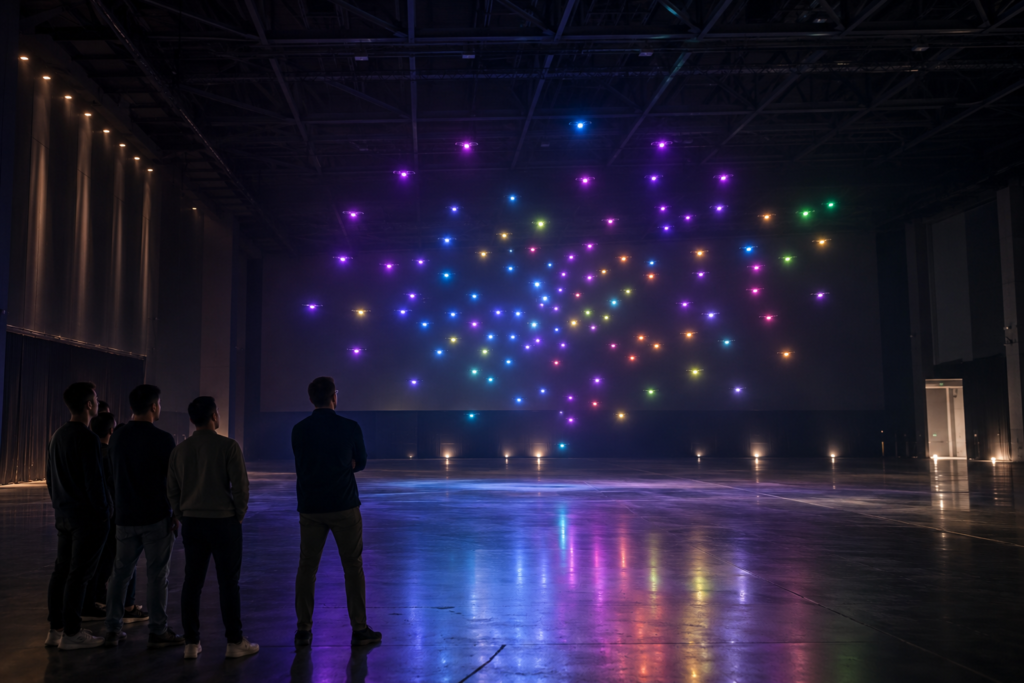
Understanding how an indoor drone show is made explains why the lead time exists in the first place. It isn’t a product pulled off a shelf – every show is designed from scratch around a specific venue, brief and audience, weeks before anyone sees it fly. Here’s the process from first conversation to final rehearsal.
Starting with the brief, not the drones
Every show starts with what the moment needs to achieve – a countdown, a logo reveal, a backdrop to a performance – rather than a fixed idea of what drones can do. If you’re not familiar with the basics yet, our overview of what an indoor drone show actually is is worth a read first.
Alongside the creative brief, the venue gets assessed: ceiling height, floor space, obstructions, and how the show fits around whatever else is happening in the room.
Designing the choreography
The flight sequence is built in simulation before a single drone leaves the ground. Formations, transitions and timing are mapped out digitally, checked against the venue’s exact dimensions, and refined against the brief – a logo needs to read clearly at the angle guests will actually see it from, not just look good from directly below.
This is also where the show gets synced to everything else in the room. Timecode – the same kind of signal used to lock lighting, video and audio together – lets the drones run in step with your existing production rather than as a separate, bolted-on act.
Safety and redundancy, built in from the start
Safety isn’t a final checklist – it’s designed into the choreography itself. Flight paths keep appropriate separation between drones and clear margins around the audience area. The drones themselves carry backup batteries and flight computers, so a single fault doesn’t mean a dropped drone; it means an automatic, controlled response.
This is one reason indoor shows use far fewer drones than their outdoor counterparts – typically dozens rather than thousands. Fewer, more heavily tested drones flying with tight redundancy tends to produce a safer and more reliable show than sheer numbers.
Client review and refinement
Once the choreography is built, it’s shown back – usually as a simulated preview – so it can be signed off or adjusted before anyone commits to a final running order. This is the point to flag anything that needs to change: timing against a speech, a colour that needs to match branding, an entrance cue that needs to move by a few seconds.
A few adjustments come up often enough to be worth planning for: swapping a logo or wording at short notice, tightening a formation so it reads better from where guests will actually be sitting, or trimming the sequence to fit a running order that’s shifted since the brief was first agreed. None of these are unusual – they’re a normal part of getting a bespoke show right.
From simulation to the real room
The final stage happens at the venue itself, ahead of the event: rigging, calibrating the drones’ indoor positioning system to the actual room, and flying the full sequence in rehearsal until it matches the simulation exactly. Only once that’s confirmed does the show move from “designed” to “ready” – the live performance itself is simply that same rehearsed sequence, flown again in front of your guests.
It’s worth stressing that nothing about the choreography changes between rehearsal and the live show. The formations, the timing, the safety margins are all locked well before doors open – the only thing that changes is the room is now full of guests instead of empty.
Why the process can’t be shortcut
It’s tempting to ask whether any of these stages could be skipped for a simpler show. In practice, no – even a short, simple formation still needs the venue assessed, the choreography simulated, and the positioning system calibrated on site. The steps scale with the show’s complexity, not away entirely, which is part of why lead time matters even for a fairly modest brief.
If you’re planning an event and want to know what this process would look like for your venue – including how it could work alongside a conference or corporate programme – get in touch at hello@inflight.show or visit inflight.show.