
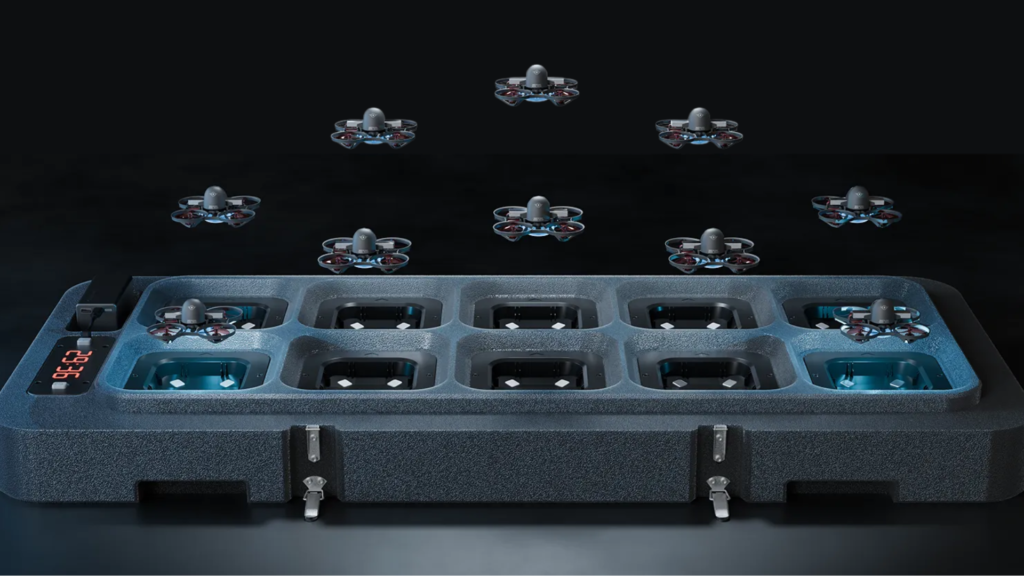
The history of indoor drone shows is much shorter, and much stranger, than most people expect. It doesn’t start with fireworks or festivals – it starts in a robotics lab, and reaches the public first through theatre and live music, years before “drone show” became a familiar phrase in events.
A robotics problem, not an entertainment idea
Flying drones safely above an audience indoors is a genuinely hard engineering problem – no GPS to rely on, no room for error near people, and a need to repeat the same performance flawlessly, night after night. Verity Studios, spun out of robotics research at ETH Zurich, spent years solving exactly that problem before the technology ever reached a stage. If you’re new to how any of this actually works, our explainer on what an indoor drone show actually is covers the basics.
That order of events matters. Indoor drone shows weren’t adapted from outdoor displays – they were built from the ground up for a completely different, much stricter set of constraints.
Theatre got there first
The technology’s public debut wasn’t a festival or a corporate launch – it was Broadway. Cirque du Soleil’s Paramour used indoor drones as “Stage Flyers” as part of its production, completing hundreds of public performances. Around the same time, Cirque’s permanent Las Vegas show MJ One built drones into its choreography as a recurring feature, several times a week.
That’s a demanding proving ground. A theatre production doesn’t get to reschedule for a technical issue – it has to work, on cue, every single night. Passing that test is a large part of why the technology went on to be trusted on much bigger stages.
Then the tours and the broadcasts
From theatre, the technology moved into live music. Metallica’s WorldWired Tour used indoor drones swarming around the band during performances. Drake’s Aubrey & The Three Migos Tour ran the same technology across dozens of shows. Céline Dion and Justin Bieber both built drone moments into world tours, using them as a visual centrepiece rather than a gimmick.
Broadcast followed. Eurovision 2025 used indoor drones as part of its production in front of well over a hundred million viewers, and China’s CCTV New Year’s Gala flew costumed drones before an audience of roughly a billion. A UK indoor swarm attempt in 2019 also set a Guinness World Record for the largest indoor drone fleet, at around 160 drones – still a small number by outdoor standards, which says something about how much can be done with relatively few drones indoors.
Beyond the stage: permanent installations
Some of the most telling milestones aren’t one-off shows at all. Madison Square Garden ran indoor drones as part of its production for New York Knicks games – a rare case of the technology becoming a recurring fixture rather than a special event. Cruise operators including Royal Caribbean and Princess Cruises have gone a step further, building permanent indoor drone shows into ships that perform the same choreography, night after night, at sea.
That’s arguably a harder test than any single tour or broadcast: the same reliability, repeated indefinitely, with no possibility of a reschedule. It’s a strong signal of how far the underlying redundancy and safety engineering has been proven over the years.
Why it stayed a small field
Given that track record, you’d expect indoor drone shows to be everywhere by now. They’re not. The redundancy, positioning technology and safety testing required to fly above people reliably indoors is difficult to build and expensive to get right, which is exactly why only a handful of companies worldwide can deliver it credibly. It’s a genuinely different discipline from outdoor drone displays, not a smaller version of the same thing – and that gap between the two is part of why indoor shows have taken this long to reach a wider range of events at all.
Where the UK fits now
That’s the backdrop Inflight is building into: a technology proven on Broadway, on world tours and on live broadcast, now becoming available to a much wider range of UK events – conferences, hotels, theatres and private celebrations, not just flagship productions. The investment is in small, nano-format drones suited to UK venues rather than the large-scale rigs built for arena tours.
For a sense of where an indoor show tends to land best today, our overview of the best events for an indoor drone light show is a good next read.
If that history has you curious what an indoor drone show could look like at your own event, get in touch at hello@inflight.show or take a look at our indoor drone light shows at inflight.show.