
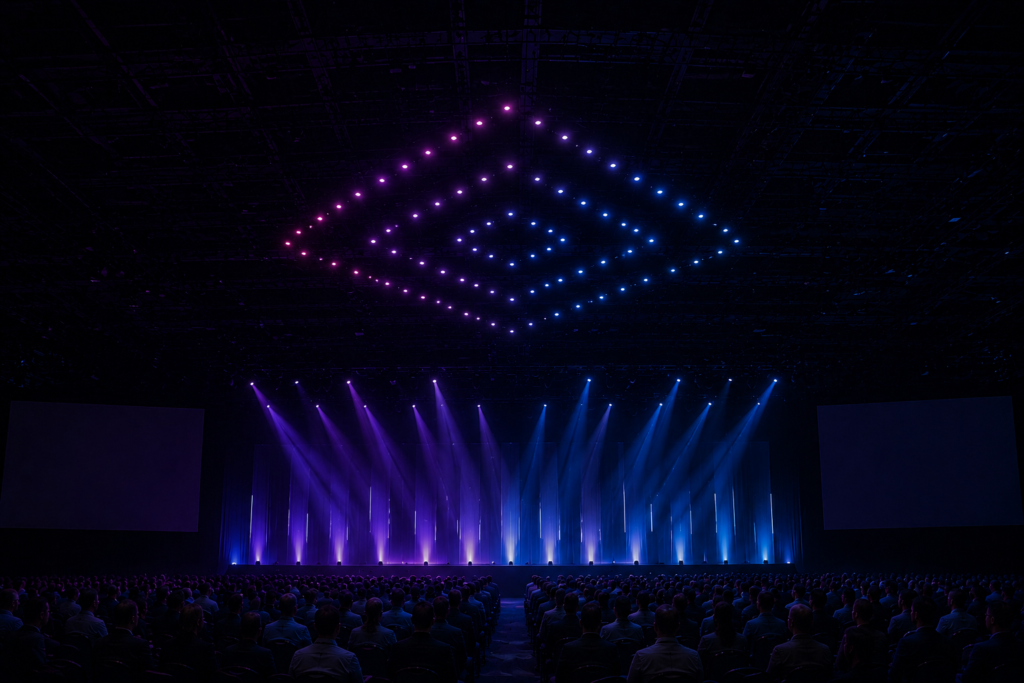
Treated as a stand-alone act, an indoor drone show is impressive on its own. Combining indoor drone shows with projection, lasers and live performers is where it tends to get genuinely memorable – not as separate elements taking turns, but as one layered production running on the same clock, each part doing something the others can’t.
The thing that makes layering possible
Drones, lighting, video and audio can all be locked to the same timecode signal – the same kind of synchronisation used across live production more broadly. That means a drone formation can shift colour on the same beat as a lighting cue, or resolve into a shape exactly as a projected backdrop changes, rather than the two simply happening near each other.
This is what separates a genuinely integrated show from drones flown as an isolated novelty – the difference tends to be obvious to an audience even if they couldn’t say exactly why.
Projection and drones
Projection mapping fills large, fixed surfaces – a stage back wall, a set piece – with detail and motion that drones can’t replicate. Drones add depth in front of or above that surface: a formation flying out from a projected scene, or drifting across open space that projection alone can’t reach. Used together, the projected backdrop gives the scene its scale, while the drones give it a physical presence moving through the room.
Lasers and lighting
Lasers and stage lighting shape the space around a drone formation – beams cutting through haze, colour washes that shift the mood of a scene – without competing for the same visual role. Because both can run from the same show control system, transitions between a lighting state and a drone formation can be built to feel like one continuous movement rather than a cut from one effect to the next.
Live performers
This is the most demanding combination, and also the most effective when it works – drones flying in relation to dancers, presenters or musicians on stage, rather than simply above them. It requires close coordination during design and rehearsal, since both the performers’ blocking and the drones’ flight paths need to respect the same safety margins.
Done well, it reads as a single choreographed moment rather than two acts sharing a stage – which is a large part of why the technology has been used in touring productions and theatre internationally, from Broadway stage flyers to drones swarming around musicians during arena performances.
Audio, too
It’s easy to focus on the visual layers and forget sound, but audio cues run on the same timecode as everything else. A musical sting landing exactly as a formation resolves, or a voiceover cue timed to a drone’s entrance, is a small detail that makes the whole sequence feel deliberately composed rather than roughly synced.
Why it doesn’t happen by accident
None of this layering works if each supplier builds their piece in isolation and hopes it lines up on the night. It takes a shared show file, a single timecode source, and enough rehearsal time for every element – drones, lighting, projection, performers – to run through the sequence together, not just separately. That coordination is invisible to the audience when it goes well, which is exactly the point.
What this means for planning
In practice, integration means the drone team works alongside your existing AV, lighting and production suppliers from early in the process, not bolted on at the end. It adds a coordination step, but it’s the step that turns a good drone show into a genuinely well-produced moment – something we factor into planning for conferences and corporate events in particular, where a full AV programme is often already in place.
If you’re planning an event with other production elements already in place and want to know how an indoor drone show could layer in, get in touch at hello@inflight.show or visit inflight.show.